If you spend time reading about the deep history of soccer in the United States, or of gridiron football in the United States, or even of rugby in the United States, sooner or later you're going to encounter the Oneida Football Club.
They end up in each narrative because, alas, at various times they have been claimed as the first official club team in the United States for any of those sports. In a way, the boys of the Oneida Football Club — who mostly met each other while attending the Dixwell School, a school that prepared young men (mostly Bostonians) to enter Harvard — could in fact be said to be the first club for any of these sports.
While history may not exactly be fictional, it is perspectival, and that perspective necessarily highlights the priorities of the present. While the boys of the Oneida Football Club weren’t really playing any of those sports, it could be argued that they were playing each of them.
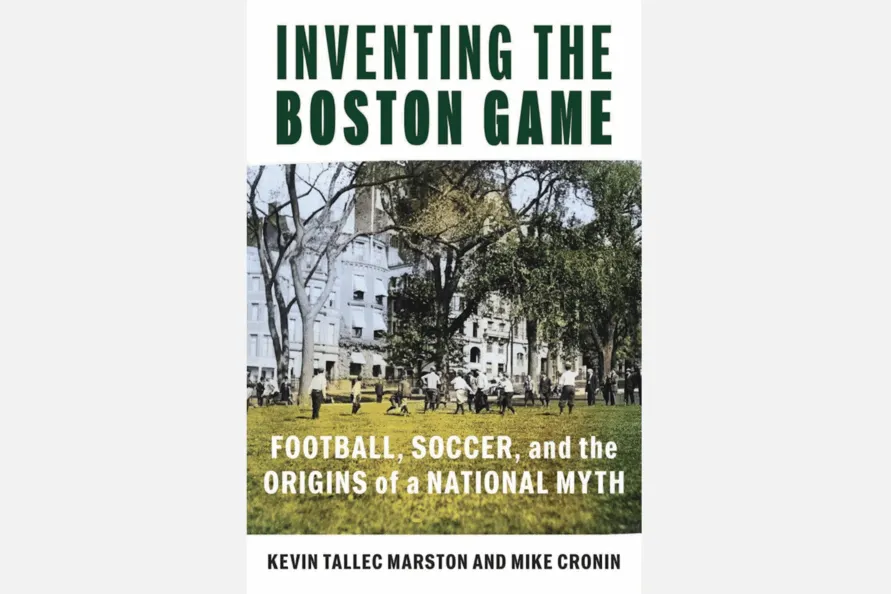
In Inventing the Boston Game: Football, Soccer, and the Origins of a National Myth, Kevin Tallec Marston and Mike Cronin provide an extraordinarily detailed and fascinating account of just how the story of the Oneida Football Club took hold and of how it has been argued over in multiple retellings.
Let me explain, or, rather, let me summarize authors Kevin Tallec Marston and Mike Cronin’s explanations: the boys of the Oneida Football Club were playing one of multiple kicking games with neighborhood- and team-specific rules that were played in the 1850s. Over time, these various kicking games began to take shape here under different codified rules.
As interested parties slowly began to create game-specific rules (the Football Association, Walter Camp’s “football,” the Rugby Football Union), distinct sports began to emerge and differentiate. So, while the Oneida Football Club was, on the one hand, not playing any of the sports we now know, on the other, they were playing all of those sports.
Without going into great detail, here’s the story: the Oneida Football Club was an extraordinarily successful team. Whatever game it was that they were playing, they were great at it. Indeed, in 1863, they played another team in Boston—one made up of players from two other schools—to determine who was the best “Football Club” in the city.
The Oneida Club won the game and kept the ball (or claimed to), putting the date and the names of the players on the ball. The ball, a somewhat roundish square, was donated in 1922 to the Society for the Preservation of New England Antiquities (nearly 50 years after the game).
At the time of the donation, a number of other moves were being made to bolster and crystallize the meaning and significance of the team. Because most of the Oneida boys were upper-class Bostonians who had gone on to Harvard and remained in contact through the elite circles of the city, it wasn’t difficult for them, once gridiron football became one of “the” American sports, to make a claim on the game they were playing.
In both a systematic and piecemeal fashion, the boys, now much older men, began to write and collect stories about what they played and sought authentication from such gridiron luminaries as Walter Camp to claim for themselves the title of “first football club” ever. Period. Indeed, in addition to the documentation, they held a ceremony to install a plaque on the Boston Commons where they played to signify their status. This sign—or a version of it—still exists.
Marston and Cronin trace out in great detail the steps the remaining members of the team took to enshrine and assure themselves of their place in history. One of the interesting aspects of this creation was that the plaque included an image of a now-traditional American football to signify the game they were playing—a ball that looks little like the ball they actually played with.
However, claims on their game were not over yet. Over time, other historians, these tracing out the history of soccer in America made the claim that the Oneida boys were actually the first soccer club in the country (a claim that seems as likely and as unlikely as their being the first gridiron club). Through a series of connections with the US Soccer Federation and Hall of Fame, the team was given this different label, and a new plaque was put up, this time with the image of a soccer ball (and their original ball was then on loan with the soccer authorities).
Not so fast: another twist: an independent historian discovers the “soccer story” and adamantly claims its inaccuracy and ultimately does a great deal of work to get the ball returned to the rightful owners and to once again alter the plaque. In short, the Oneida Football Club went from playing an obscure kicking game to being the first football club to being the first soccer club and back to being the first football club without ever playing again.
Ultimately, it matters little to anyone outside the boys themselves or their ancestors what sport they were playing and where they land in history. They were playing a kicking game, and they were good at it. The book, however, is invaluable in the detail with which it traces out how the Boston game was “invented” in retrospect and how a national myth gets constructed and repeated. The value of this volume, then, lies less in the specific case and more in the general (but detailed) notion that myths and stories are crafted and crystallized to fit the present rather than the complexities of the past.
It’s hard to express just how highly I regard this book. With a mixture of newspaper research, archival work, and interviews, Marston and Cronin weave a story that almost feels like a page-turning mystery.