With the 2026 FIFA World Cup kicking off today, we're launching a brand new scorigami bot on Bluesky to bring an exciting and underutilized level of analysis to this tournament.
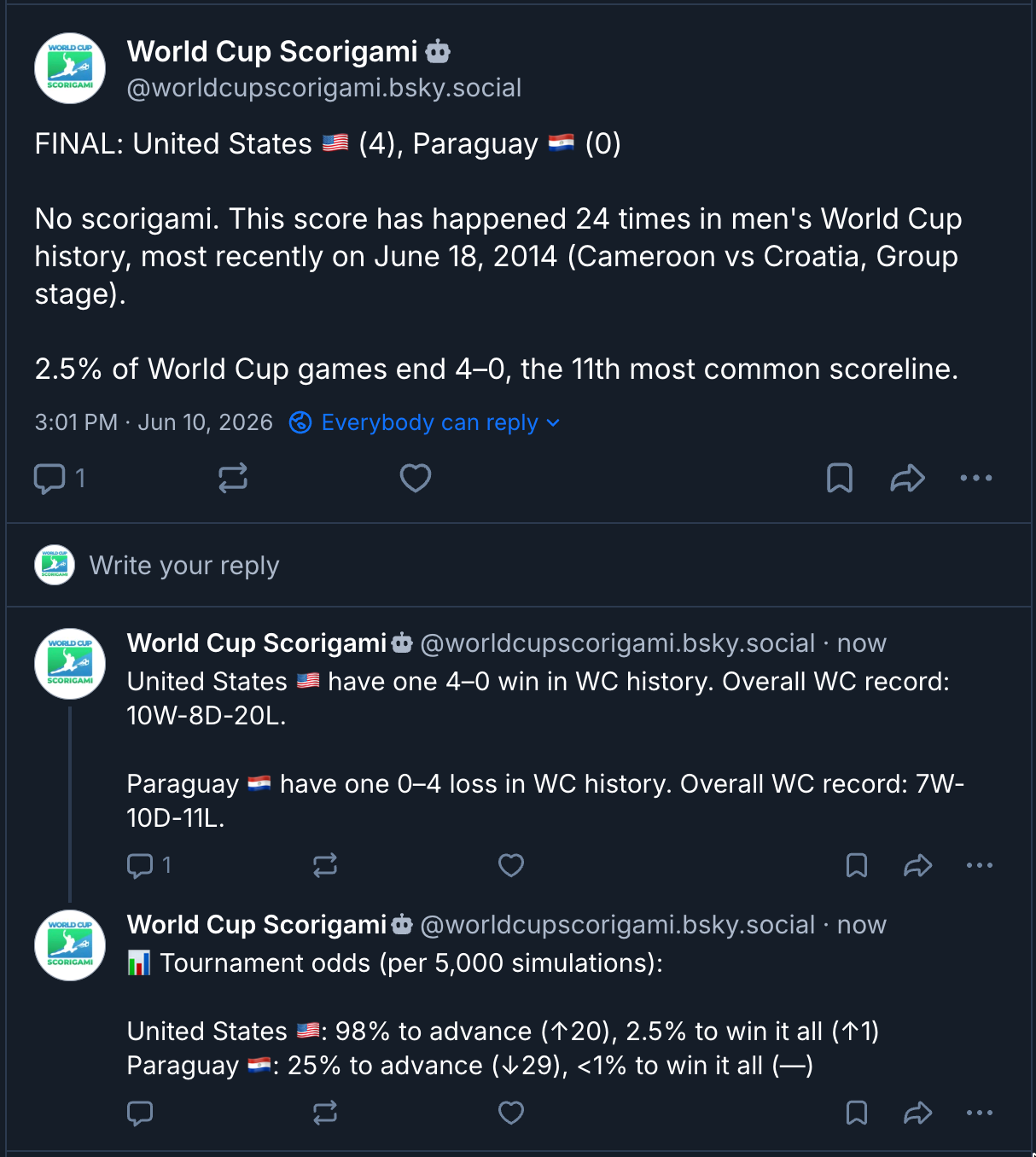
A scorigami is a final score that has never happened before in a league's history, a concept invented by Jon Bois for the NFL. We've applied it to the FIFA Men's World Cup, tracking every result since the tournament began in 1930.
You can follow @worldcupscorigami.bsky.social on Bluesky for a post after every World Cup final whistle. We've also built a dedicated page on our site to show the matrix of all-time World Cup scorigamis.
 Ben Wright
Ahead of the World Cup, our model ran 5,000 simulations, based on FIFA's world rankings, to predict the winners of the 2026 tournament.
2026 World Cup Forecast
Pre-tournament projection from 5,000 Monte Carlo simulations using FIFA Elo ratings and the official 2026 bracket. Updated June 11, 2026.
5,000 simulations · FIFA Elo (April 2026) · Official 2026 bracket · @worldcupscorigami.bsky.social
The forecast you see attached to each match thread comes from a Monte Carlo simulation that runs 5,000 times every time a result comes in. Here's how it works.
The rating system
Every team in the tournament has an Elo rating sourced from FIFA's official April 2026 rankings — Argentina at 1875, Spain at 1876, France at 1877 at the top, down to New Zealand at 1281 at the bottom. These rankings certainly aren't perfect, but they're a starting point.
The model then converts these numbers into match probabilities using a standard Elo formula: it takes the rating difference, divides by 600, and runs it through a logistic curve to get the favorite's chance of winning. For close matches, the model also accounts for draw probability, which peaks around 22% when teams are evenly matched, and shrinks when there's a clear favorite.
Group stage simulation
For each of the 5,000 simulated tournaments, our bot plays out every remaining group match using those win/draw/loss probabilities. When a goal-scoring outcome is needed, it draws a realistic scoreline (1-0, 2-0, 2-1, etc.) weighted toward the result type. After all group matches are simulated, it sorts each group by FIFA's actual tiebreakers — points, goal difference, goals scored — and identifies the two automatic qualifiers per group plus the eight best third-placed teams.
The knockout stage
Instead of building a random knockout bracket, our bot uses FIFA's actual 2026 bracket, hardcoded from the December 2025 draw. This ensures that the correct group-stage teams are paired against each other, and is based on the actual bracket principles.
The path from the Round of 32 through to the final is fixed, based on the simulated results of the group stage. This means a team that finishes second in Group A doesn't avoid a team like France just because the random seed felt like it. Instead, they go where FIFA's bracket has them.
Per-match probability impact
When you see "↓3" next to a team's title odds in our Bluesky post after a result, that's an actual before-and-after comparison. The bot runs the full 5,000-simulation forecast twice: once with the standings as they were before the match, and once with the new result included.
The delta is the actual impact of that result. A group stage scoreline like a 4-0 win will show a larger probability to advance from the group than a 1-0 win, because the simulator's tiebreaker logic includes goal difference, and because goals scored matter when group teams finish on equal points.
What the model gets right and where it has trouble
The 5,000-iteration sample size gives precision of roughly ~0.7 percentage points on a 50/50 probability, which is invisible at the post's rounding. The real bracket also pits teams head-to-head in realistic matchups, meaning our win percentages account for a team's actual path to the final.
The model doesn't include any of the very real factors like form, injuries, tactical matchups, or any of the intangible variables that will have significant real-world impacts on the tournament.