Last season, around June, I put together a list of criteria that most Supporters' Shield candidates accomplished on their path to the Shield.
At the time, Nashville met about 50% of the criteria and eventually finished the season with only three of the eight boxes checked. Philadelphia Union ended with seven of eight boxes checked and ended up winning the Shield.
Through 14 matches in 2026, Nashville are off to a better start and look set to again challenge for the Shield, but they’ll need a strong back half to carry them over the line.
Let's dive into the same criteria and look at how Nashville stack up so far.

Nashville SC and Major League Soccer are back in action, and we're here to cover it all in-depth. Sign up for a new annual membership and save 30% on your first year!
Home form
• Nine of the last 11 winners lost two or fewer home matches
It's an excellent start for Nashville here. The foundation for any successful MLS season is built at home, and Geodis Park has been a fortress. Nashville are 6W-1D-0L through seven regular-season home games, and with 10 more home games on the schedule, they need a meager 6-2-2 record to hit both criteria.
Nashville’s attack has been on fire, scoring 23 goals at home this season. That’s the most on a per-game basis in MLS. The only time they dropped points was when they came back from down two goals against DC United, four days after an exhausting heartbreaker down in Monterrey to Tigres.
Last season, Nashville did not hit either of these marks, mainly due to their struggles breaking down a low block. I’m not sure that they’ve permanently fixed this problem, but they have found a temporary solution: opposing teams can't sink into a low block when they’re behind.
Nashville have scored a goal inside the first 20 minutes at home in five out of their seven home games. The two times they didn’t were the tie against DC United (which also happens to be the lowest average defensive line they’ve faced at home this year) and Minnesota United, against whom they scored in the 25th minute. The path to continued success at home is clear: score on opposing teams early, force them to come out, then punish them.
Road form
• Nine of 11 scored at least 24 goals away from home
The 'Yotes split this category, pacing for only 19 goals, but they’re averaging two points per game on the road. Points are what matter, so the lack of goals on the road isn’t an issue if NSC keep earning points.
I do, however, think it’s an interesting look at how Nashville have been successful on the road. To date, the Boys in Gold have allowed just two goals on the road. This isn't per game, but in total! This puts them on pace to concede just five away goals this season, which would be the best record in MLS history.
It’s highly unlikely they'll keep that pace through the season, but that defensive foundation will carry them through road matches and a Supporters’ Shield challenge.
Expected goal differential
This is another criterion in which Nashville SC fall short.
The 'Yotes have been skating by on good fortune for some time, and there are warning bells that the pace they’ve been on has maybe been a bit of fool's gold. According to FotMob, Nashville SC has an expected goal differential (xGD) of 3.1 – a meager .22 xGD per 90 minutes – which puts them on pace for an xGD of only +7.5 over the entire season, missing the criterion by a considerable amount.
I’ll get into this more at a later date, but despite the warning bells, I’m not too concerned. As we mentioned, Nashville have been very good at scoring early, which tips the game state in their favor. This means their opponents will push harder for goals while Nashville SC defends, creating a negative xGD but not affecting the scoreline or actual goal differential unless they score.
Another reason I’m not overly concerned is that Nashville went on one of the most impressive runs in Concacaf Champions Cup we’ve ever seen from an MLS side, beating Club América and reaching the semifinals before falling to Tigres. Generally, when MLS teams go that deep in Concacaf, their MLS play suffers.
That explains the numbers dip we’re seeing from Nashville. In the graph below, you can see the xGD dip as Concacaf intensity increases and the fixtures pile up.
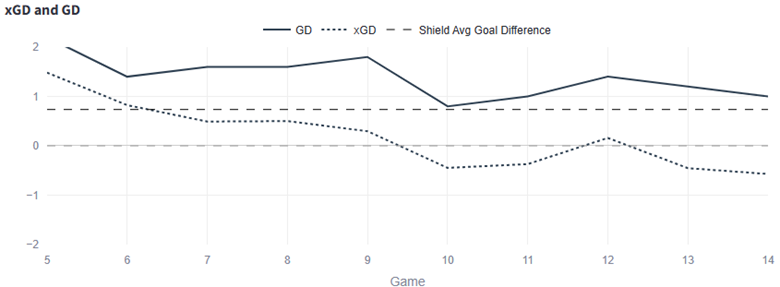
Game nine on the chart below is when the decrease becomes apparent, which was against Charlotte at home and sandwiched between Club America and Tigres matches.
Patrick Yazbek would only play one more MLS game after this mark, getting injured at Tigres. Sam Surridge subbed on late to grab a brace before picking up an injury that would see him miss every match until the final game before the break.
These are very valid reasons for the drop-off in xGD. We should celebrate the points despite the poor performances, because I think the performances will improve with only one competition to focus on, a fully healthy roster again, and a transfer window to make key reinforcements.